
What's the Buzz?

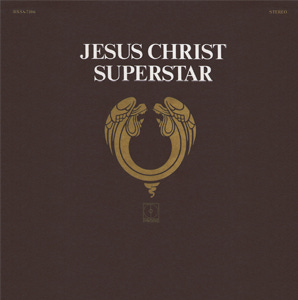
If you were a Mass-goer back in the 70’s – gulp – 50 years ago – fifty! - especially if you were in high school or college, you might have rolled into Palm Sunday Mass with this going on:
Yes, ma’am, it was a time. Along with everything else going on liturgically, we had the Serendipitous Invasion of the Pop Jesus Musicals: Jesus Christ Superstar and Godspell.
I’ll put my cards on the table right away. Won’t be coy, and am not a bit embarrassed about it: I don’t hate either of them and I like Lloyd Webber’s music for JCS quite a bit. However, the current fashion in JCS revivals with stunt casting: Cynthia Erivo as Jesus in the Hollywood Bowl last year and this summer, at the London Palladium, rotating Herods ranging from Jesse Tyler Ferguson to Boy George – each getting a chance to camp out with “King Herod’s Song” – is pretty tedious.
I don’t even care much about any of the stage productions at all, not even the movie – I’m all about that big old brown LP – that’s enough for me, since that’s where it all started.
You know that right? Jesus Christ Superstar began, not as a stage musical, but as a concept album because Webber and Rice couldn’t get funding for a stage production. You don’t need to see it onstage to get the intended effect, not really.
But I’m not here to discuss the history of either piece in itself, but to reflect on their roles in the lives of Catholics in that period this blog is all about: those post-Conciliar years.
Timeline first:
The Jesus Christ Superstar album was released in 1970. It opened on Broadway in 1972. The movie was released in 1973, and an American tour – very important in its popularity – began in 1976.
As for Godspell: It began as a Master’s thesis by John-Michael Tebalak at Carnegie-Mellon in 1970. It was produced off-Broadway in 1971, at which point Stephen Schwartz was brought in to write an almost completely new score. It made it to Broadway in 1976, but in between – in 1973 – it made it to the screen. **
Which means they both fell into the laps of enthusiastic young Catholic liturgy committee members, musicians, educators and clergy right at the perfect time: That Catholic 70’s Show.
To be clear: I never experienced Hosanna! at Mass. Hey JC, JC won’t you smile at me, Sanna ho, sanna hey Superstar! would have been too much in the more conservative south even in a more-liberal college parish. Besides, the charismatics ran the music in that place, I don’t think they approved of JCS at the time.
But we did do Prepare Ye from Godspell during Advent, clapping, I’m sure, and we did sing Day by Day during Mass – but then those lyrics are from, well, the Gospels and a 13th century prayer by Saint Richard of Chichester, respectively.
In or outside of Mass, we loved both shows. We knew the music, sang it, danced to it, played them in coffeehouses. Did we see them as anything but music about our professed favorite Person, glad, but not surprised that He was popular? Not really.
At the time, Catholic reactions to both – especially JCS – ranged from scandalized to appropriating. So what about that? Do these shows corrupt, dilute and do general damage to the truth of the Gospel or are they invaluable tools in getting the Word out?
Neither, I’d say.
Any creative work is going to tell us something about the time in which it was made – sometimes more than about the subject itself. So of course, both of these reflect the values and thinking of 60’s and 70’s.
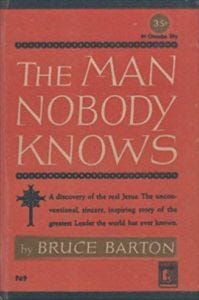
Just as, if we were thinking about this back in the 1970’s, we might look fifty years before then, at a book called The Man Nobody Knows, written by one Bruce Barton and the top-selling non-fiction title in 1925. In it, Barton presents Jesus – consistent with the Main Street interests of his time – as “the world’s greatest business executive” and the “Founder of modern business” who built a crackerjack global organization beginning with just twelve ordinary guys!
Only time will tell if something is timeless.
And really, even by the late 90’s, Godspell, at least, was showing its age. A theology teacher – and I swear it wasn’t me, it was someone else in the department – showed the movie to the kids. They weren’t impressed. It didn’t speak to them. It didn’t reveal truths about Jesus in relevant ways. They didn’t think it was cool. They thought the music was catchy, but the rest? The whole thing? Awkard. Laughable, but not in a good way.
I suppose you could – and some probably do – make the argument that the very existence of these two shows, with their conflicted Jesus, their hippie Jesus, their rock and pop rhythms and – this was the dig on both shows, the reason Catholic schools weren’t supposed to perform them – their lack of a Resurrection – are countersigns to the truth.
I don’t. But nor do I think it’s wise to use them – or any pop culture product, even, yes, The Chosen- as a centerpiece for the presentation of the Gospel, whether that be in a classroom, retreat or in your local megachurch’s Message Series. And when that happened during liturgies back in the day, well, it shouldn’t have. It did distract from the truth and beauty that should be at the heart of what people encounter when they encounter the Church.
But yet…both offer insights. Insights about the person of Christ, perhaps, but most importantly, insights about us. About how human beings responded to Christ then – and now.
In Jesus Christ Superstar, no one really understands Jesus, he’s not valued for his teaching or anything particularly spiritual, but for the buzz he creates – his celebrity, his superstardom. This is not a crazy take, is it now? Admit it.
Godspell is a little silly, a vaudeville, a circus with catchy tunes but is, in the end, about something serious: the formation of community.
Both reflect that 60’s and 70’s vibe. Critiques of superficial social mores, corrupt powers, sympathy for misunderstood outsiders. Fun frisky young people forming a joyous happening. One cynically despairing about the human reaction to goodness, the other, almost unbearably, naively idealistic.
Nonetheless, neither of them entirely wrong, when you think about it, about the varied - and variable - responses to Jesus.
You might even say: timeless.
**A fun note: The 1972 Toronto production of Godspell features a spectacular cast, many of whom went on to great comedy careers: Martin Short, Eugene Levy, Dave Thomas, Gilda Radner, Victor Garber, Andrea Martin and Jayne Eastwood, with Paul Shaffer (who was the bandleader on David Letterman’s late night show) serving as musical director.
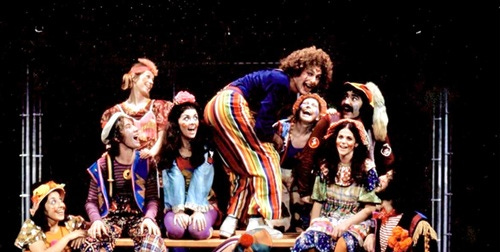
Last year, a documentary about this production, You Had To Be There: How the Toronto Godspell Ignited the Comedy Revolution, Spread Love & Overalls, and Created a Community That Changed the World (In a Canadian Kind of Way) was released on the festival circuit. Unfortunately (can we say tragically? ) no film footage of this production exists, so the documentary is apparently composed of interviews and some animated footage – but has still received excellent reviews. I can’t wait to see it.